
Recent News

What Is PAYG Withholding?

PAYG vs GST

BAS vs Tax Return
Download:
Get in touch with us
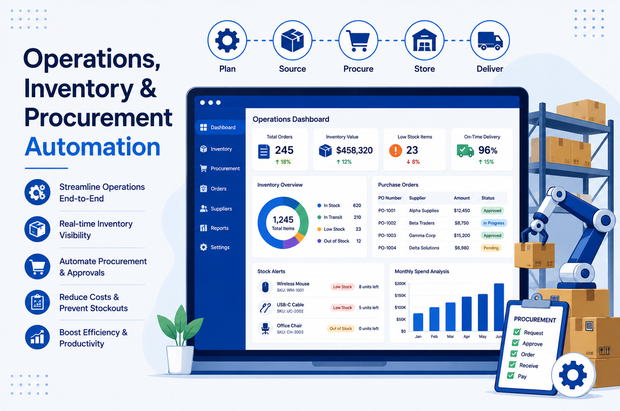
The Problem
Growing businesses frequently manage orders, stock levels, suppliers and operational reporting through multiple spreadsheets and disconnected systems.
This can create stock shortages, excess inventory, missed orders and considerable administrative work.
AI Automation Solution
An intelligent operations workflow can:
- Consolidate orders from different sales channels
- Monitor inventory movement
- Identify unusual stock movements
- Forecast potential inventory requirements
- Generate low-stock alerts
- Prepare purchase-order recommendations
- Compare supplier information
- Track outstanding purchase orders
- Automatically prepare operational reports
- Alert management when predefined exceptions occur
Example Workflow
Sales Data + Inventory + Purchase Orders → AI Analysis → Demand/Exception Identified → Recommended Action → Manager Approval → Workflow Triggered
Instead of discovering operational problems after they happen, management gets earlier visibility and actionable information.
Real-World Examples of AI & Workflow Automation
These examples illustrate what organisations have already achieved with AI and workflow automation. Results depend heavily on process design, data quality, transaction volume and implementation, so they should be treated as evidence of what is possible rather than guaranteed outcomes.
Finance — Intelligent Invoice Processing
Concentrix developed an AI-enabled invoice-processing system using Microsoft Power Platform, AI Builder and GPT-based extraction. According to Microsoft’s published case study, the system processes more than 100,000 invoices per month across more than 300 layouts and achieved 96% overall accuracy, reaching 99% in January 2026
SME application: The same principle can be applied at a smaller scale to supplier invoices, purchase-order matching, accounting entry preparation and exception management.
Customer Service — Automating Repetitive Support
Erewhon implemented extensive workflow automation across its 10 stores. Zapier reports that its AI-powered customer-service workflow handles approximately 70% of tickets without human modification, alongside broader automation processing around one million tasks annually.
SME application: Automate repetitive enquiries while sending unusual, sensitive or higher-value cases to employees.
Sales — Lead Qualification & Follow-Up
Published automation examples show how AI agents can enrich leads, evaluate them against Ideal Customer Profile criteria, draft personalised outreach, update CRM records and route opportunities to sales representatives. One published case study reports reducing lead-qualification work from 3.5 hours to four minutes per lead through an AI-assisted workflow with human approval.
SME application: Particularly useful for businesses receiving high enquiry volumes through websites, email, advertising or WhatsApp.
E-Commerce — Orders, Inventory & Customer Communication
A published case study involving a Kolkata-based e-commerce business describes a five-person team spending approximately 15 hours per week on activities including order exports, spreadsheet updates, invoice generation and inventory synchronisation. Following workflow automation, the case study reports reducing this to approximately 45 minutes of weekly monitoring.
SME application: Connect Shopify, marketplaces, accounting software, payment gateways, inventory systems and customer communication into coordinated workflows.
Business Operations — Reporting & Administrative Automation
Automation can also eliminate substantial internal administrative work. Zapier reports examples including Vendasta recovering $1 million in pipeline and removing the equivalent of 282 days per year of manual work, while Arden Insurance Services reports more than 34,000 work hours automated.
SME application: Management reporting, CRM administration, document processing, approvals, data consolidation and recurring operational tasks can often be automated without replacing the underlying business systems.
Our Approach: We Automate the Problem, Not Just the Task
Successful AI automation starts with understanding why a process is inefficient.
01 — Understand
We speak with your team and understand how the process actually works today.
02 — Identify
We identify repetitive activities, bottlenecks, duplicated work, manual data entry and opportunities for automation.
03 — Design
We design an AI-enabled workflow around your business rules, systems, controls and approval requirements.
04 — Integrate
Where technically feasible, we connect AI with your existing business ecosystem — accounting software, CRM, ERP, email, spreadsheets, cloud storage, e-commerce platforms and internal databases.
05 — Control
Important transactions and decisions can include human-in-the-loop approval, exception management and audit trails.
06 — Improve
Once deployed, workflows can be monitored and refined as your processes, transaction volumes and business requirements evolve.